Showing posts with label Fluency. Show all posts

Sunday, June 21, 2015

TPT Summer Challenge Week One: Makeover Madness

I joined the ladies over at Third in Hollywood, Sparking in Second, Peppy Zesty Teacherista, and Teach Create Motivate for a TPT Seller Challenge.  

The challenge for week one?  Makeover Madness.  I instantly had big plans for giving several of my products a face lift, but I soon was thrown an extra challenge.  The keyboard on my laptop stopped working.  It already takes a decent chunk of time to create (and recreate) products for TPT, but not being able to type or use basic shortcuts has been quite the extra challenge.  

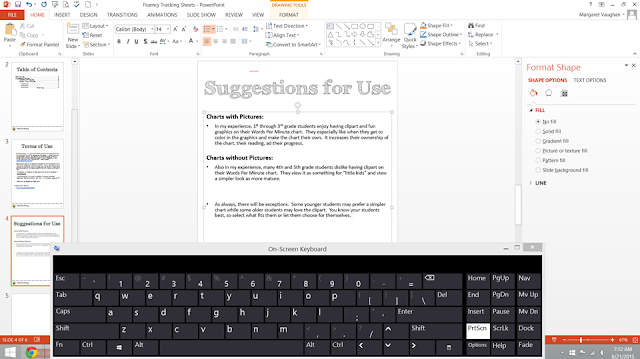
I was determined to make this work though, so with the help of my computer's handy on-screen keyboard, I was able to update one of my freebies.  

On-Screen Keyboard
Using my On-Screen Keyboard to Update my Reading Fluency Charts

What is an on-screen keyboard, you might ask.  Well, I don't recommend using it unless absolutely necessary because it is just that - a keyboard on your screen that you have to move your mouse to click on each letter you want to type.  It is rather time consuming.  

Even with this set-back, I persevered (after dragging my feet for several days).  So I present to you an updated version of my Reading Fluency Charts:

Reading Fluency Charts

Reading Fluency Charts


The cover had a face-lift and the charts themselves now come in two versions: one with clipart that will appeal to younger students and one with a simpler designed (without clipart) that will appeal to older students.

If you're interested in grabbing this updates freebie, head over to my TPT Store by clicking here: Reading Fluency Charts.

Let me know what you think of the new look and enjoy!

Friday, April 25, 2014

Friday Freebie: Punctuation Fluency

A month or two ago I saw an awesome idea on Pinterest. A teacher had combined letter naming practice and reading with correct punctuation inflection into an awesome activity.  It was fantastic, and I immediately put the idea to use.

However, in my excitement about this idea, I apparently forgot to repin it, and now I cannot find the pin or the picture anywhere despite an extensive search.  (Be forewarned:  searching for "abc. def?" will produce surprising number of images of women in their bras.)

Essentially the teacher had written chunks of three to four letters in alphabetical order.  Each of these chunks ended with a punctuation mark.  Brilliant!  As younger students practice letter naming they can also practice reading with proper inflection and intonation as they encounter various punctuation marks.

The pin I saw had the series of letters written out on large paper, which would be great in a classroom.  However, since some of my interventions take place outside of my classroom (like in the hallway), I need something more portable.  I quickly made these strips:  Punctuation Fluency.


I've been using them for the last few weeks and my students LOVE them!  It is a fun, quick intervention that provides fast results.

The best part?  Older students love them too!

Initially, I thought I would use these strips mainly as a letter naming/punctuation fluency combo with younger students.  But some of my older students race through texts, ignoring any sign of punctuation.  These strips have also helped them learn to slow down and improve their prosody, which in turn will hopefully help their comprehension.

You can download the Punctuation Fluency strips for free here:  Punctuation Fluency.

If you use these strips in your classroom, I'd love to hear how they worked for your students.  Also, if you know of the pin I'm talking about, I'd love if you shared the link with me!  Thanks!


Thursday, November 22, 2012

Ideas for the Classroom: Bear Hunt


This short two-day Thanksgiving week was going to be great.  I just knew it.  I was in a good mood.  My students were in a good mood.  What could go wrong? 

Well, pretty quickly Monday morning I realized that many of my students hit Thanksgiving overload.  They had done so many fun Thanksgiving activities in class, that coming down for reading intervention to find yet another thanksgiving activity left them less than enthused.

Glancing around the room for an idea as my disappointed second graders sat in front of me, I pieced together this game that I am calling “Bear Hunt.”   I used it all this week (all two days!) and my students love it.  Here it is:

Friday, October 26, 2012

Friday Freebie: Fluency Tracking Sheets

Since I mainly work with students in Tier III interventions, it is vital that I track their progress, but all students benefit from timely monitoring of their progress.  Formative assessments provide teachers with so much information.  Are the students on track?  Are they growing?  Are they growing at a rate that will allow them to get on track with their peers? 

If the answer to any of these questions is no, then we as teachers know that something needs to change.  If I look at the results of progress monitoring and see a stagnant line, that tells me I need to change the interventions my kiddos are getting.  Obviously these particularly strategies are not working with these particular students. 

One area that many of my students are working to improve is their reading fluency.  To help track their fluency progress, I created four Fluency Tracking Sheets


The four sheets have different ranges of words per minute on them, making them useable for any grade level.  They are great visuals for seeing how students are progressing.  They're available for free on TPT.  You can get to them by clicking: Fluency Tracking Sheets.

I hope you find them useful too!


.

Monday, October 1, 2012

Reading Research Monday: Phonics Phones

When students, especially young students, read they often are so focused on decoding words and comprehending what they’ve read that they don’t have a good idea of what they actually sound like when they are reading.  Struggling readers might not know how long it takes them to sound out a word or that the sound they are actually saying out loud isn’t the sound they think they are saying.  One way to help with this issue is by using Phonics Phones (sometimes called Whisper Phones). 

Friday, July 20, 2012

Fluency: The Basics


Definition

Fluency is the ability to read words effortlessly and accurately with correct prosody (proper rhythm, intonation, expression, etc.).  Fluent reading is an essential step toward building reading comprehension.  If a reader is not fluent, then he will spend too much time and attention on decoding words which will detract from his ability to create meaning from the text. 


Research Findings

The University of Oregon's Center for Teaching and Learning cites Hasbrouck (1998), stating that successful, fluent readers:
  • Rely primarily on the letters in the word rather than context or pictures to identify familiar and unfamiliar words
  • Process virtually every letter
  • Use letter-sound correspondences to identify words
  • Have a reliable strategy for decoding words
  • Read words for a sufficient number of times for words to become automatic 

The National Reading Panel unfortunately found few studies that met their review criteria to be included in their study of fluency research.  However, they did examine fourteen studies.  One interesting finding from this research relates to the widely held belief that independent silent reading increases students' reading abilities.  There are numerous studies to support the claim that the best readers read the most and the poorest readers read the least.  However, this is correlation not causation.  There is not enough research to show that good readers are good at reading simply because they read a lot.  Maybe they read a lot because they possess the skills that allow them to read.

In its review of qualified studies, the NRP found no positive correlation between having children participate in silent, independent reading with little to no instruction or feedback from a teacher and increased reading skills or fluency.  It is important to note that they did not find a negative correlation either.  Simply, there isn't enough research to support the idea that having children read a lot will directly translate into developing better readers.

One approach that the NRP did find effective for increasing fluency (as well as word recognition and comprehension) are using repeated oral reading procedures that are guided by teachers, parents, or peers.  The effectiveness of this strategy was seen across grade levels, in regular and special education classrooms, and it increased reading skills for both good and struggling readers. 


Approaches to Instruction

Through Harcourt, Steck-Vaughn released an analysis of the NRP's findings on fluency as they relate to effective instruction.  A list of these instructional approaches and strategies are listed below:

  • Repeated Oral Reading
  • Teacher Guided Reading
  • Peer Guided Reading
  • Modeling Fluent Reading
  • Previewing Reading
  • Choral Reading
  • Echo Reading
  • Tape-Assisted Reading
  • Paired Reading

Obviously some strategies, like the Tape-Assisted Reading, can be modified for current technology.  A cassette still works well, but so does an iPad, an iPod, a computer, or many other devices.  What you use depends on the resources you have.  Also, all of these strategies can be implemented with any curriculum to help build fluent readers.  These approaches can even be used in other content areas like science or social studies to improve fluency (and with it word recognition and comprehension).

Tuesday, July 17, 2012

The Five Essential Components of Reading Instruction

Extensive research shows that there are five essential components for reading instruction.  And when I say "extensive research," I'm not asking you to just take my word for it.  For two years the fourteen members of the National Reading Panel met to discuss their findings of the research they examined, and they prepared two reports and a video based on their conclusions.  The International Reading Association also uses scientifically-based research to determine standards for reading professionals.

From these sources (and others), five areas emerge as essential to building a comprehensive and effective reading program:
  1. Phonemic Awareness -  the ability to hear, identify, segment, and manipulate phonemes
  2. Phonics - the ability to use phonemic awareness in relation to the alphabetic principal to understand that letters represent sounds
  3. Fluency - the ability to automatically recognize words and read them with proper pace and prosody
  4. Vocabulary - the set of words a person is familiar with and able to use accurately
  5. Comprehension - the ability to gain meaning from texts

While it is agreed upon that these five aspects of reading are necessary in developing strong readers how they are implemented, to what degree, and how they should be assessed (particularly with regard to comprehension) often spark debate.  It would be wonderful if there was a specific, step-by-step process for including these components into a reading program that would instantly produce quality readers in all schools.  Unfortunately, a guide like that does not exist.  But it should not deter us. 

By using scientifically-based reading research schools, teachers, and parents can help children succeed and produce strong readers.  It just takes a little thinking and some effort to find what those students need and to develop a curriculum and interventions that will continue to build their strengths while addressing their weaknesses.  It may seem daunting at first, but with research as a guide, it is more than feasible. 
Related Posts Plugin for WordPress, Blogger...