Showing posts with label Phonemic Awareness. Show all posts

Friday, January 2, 2015

NO PREP Letter of the Week Packets Plus a Freebie!


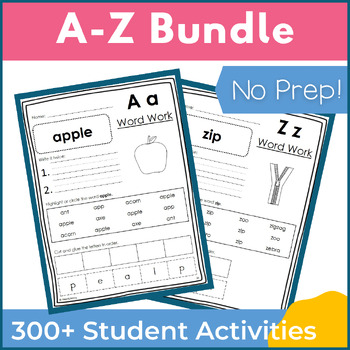
One of my best selling packs is my NO PREP Letter of the Week A-Z Bundle.  It offers a year's worth of lessons on letter naming, letter identification, and letter-sound correspondence while also building vocabulary, handwriting skills, and word building skills.  


Until recently, I've kept this pack as a year-long bundle.  However, I've had several requests for it to be broken up by letter, so without further ado, here are the NO PREP Letter of the Week packets:


Each packet includes 12 activities plus a bonus take-home BINGO game to help build the school-home connection and extend learning at home in fun ways.  I use these packets with grade-level and below-grade level kindergartners as well as an RTI intervention with 1st graders.  

Also, I am offering the NO PREP Letter of the Week T Packet for free!  You can download the whole packet for free here:  Free Letter of the Week Packet.

Free Letter of the Week Packet
FREE!

If you like it, check out all of the other Letter of the Week Packs or the Year-Long Bundle for 20% off!

Happy Teaching!

Saturday, November 15, 2014

A Thank You Freebie!

With Thanksgiving upon us, I'd like to say thank you to my followers and thank you to all the teachers out there who work so hard (physically, mentally, and emotionally) for their students.

For the next 24 hours my new Phonics Letter Work: P Packet will be FREE as a thank you for your dedication to students.


I use this packet with grade level kindergartners and as an intervention for letter naming, letter sounds, and letter recognition for 1st grade and 2nd grade students.


Again, thank you for all you do for our children!  It is appreciated!   :)

Tuesday, June 17, 2014

Great YouTube Channel for Phonics, Sight Words, and More!

If you are looking for fun songs to help teach your students the alphabet, letter names, letter sounds, and even sight words, check out Have Fun Teaching.

I have several students who just start singing in class.  They are in kindergarten or first grade, and while they are still mastering letter sounds, they are able to sing out lines of text like, "Lately I've been, I've been losing sleep..."  While I'm sure they have little idea of what the lyrics from pop songs mean, imagine if that type of automaticity could be achieved for letter names, letter sounds, and even for spelling sight words!

Here are just a few of Have Fun Teaching's videos:

What Do the Letters Say? (What Does the Fox Say Parody)


Alphabet Song


Letter F Song


The "Are" Song


Tuesday, August 6, 2013

Resource Round-Up: August 6, 2013

Today's Resource Round-Up is devoted to Word Walls.

What is a Word Wall?
It's an organized collection of words that you display in a very visible way in your classroom.  It is a great tool for beginning readers and writers as it shows the phonemic relationship between words while also letting children learn and apply phonics skills. 

Different Types of Word Walls
Word Walls are very versatile.  Some common types are:
  • High Frequency/Sight Word Word Wall
  • Seasonal Word Wall
  • Word Family Word Wall
  • Content Area Word Wall
  • Spelling Words Word Wall
  • Frequently Misspelled Word Word Wall
  • Literature Based Word Wall
  • Student Created Word Wall

Here are a few examples of Word Walls:

1. Culture, Curriculum, Change!


2. Flamingo Fabulous in Second Grade


3. A Teacher's Idea


4. Hammond Indian School District


5. Classroom Teacher Resources


Tuesday, April 23, 2013

Resource Roundup: April 23, 2013

Here are a few recent  posts you might like:

14 Words That Are Their Own Opposites:  I can see some synonym and antonym fun here

Phonemic Awareness Activities Make Early Reading Skills Playful: Includes fun ideas like "shopping" for letters and sounds

20 Great Websites for Elementary Educators: The name says it all

20 Great Websites for Elementary Educators - Websites for Teachers


.

Wednesday, February 6, 2013

28 Days of Free Literacy Resources, Ideas, and Tools: Day 6 - Books with a Beat


Gail from Joyful Noise Express offers this list of some of her favorite story books that include rhythm and rhyme to help make learning time active and fun.   

You can find her free list here: "Books with a Beat" Book List

Thursday, October 25, 2012

Ideas for the Classroom: Word Spinners


Back in August when I entered my new classroom for the first time, I spent most of the day going through the piles of resources in the room.  Most seemed unorganized.  I found several intervention resource series with at least one book missing, piles of miscellaneous worksheets, papers shoved in corners, a tub of reading games, and a box of random items.  I'm sure there was some order to the room that made sense to the person who was there before me, but I was lost.

I immediately started organizing things by priority.  The last box of random items fell to the bottom of the list.  Recently, however, I reopened that box, and found a packet of black arrow spinners, and I started wondering how I could use them.

Spinners are fun. I loved them when I was a kid, and it makes learning seem more like a game.  There is excitement in and anticipation when you get to spin something.  Where will it land?  What will I get?

So after thinking about my kiddos needs and what they were struggling with, I came up with these CVC spinners.

Basic Spinners


They are pretty simple and easy to make.  All you need is:

Tuesday, October 23, 2012

Ideas for the Classroom: Alphabet Game

Many of my first grade intervention kiddos need help with letter naming and letter sounds.  For a fun way to help them master these skills I made "The Alphabet Game," which is extremely customizable for whatever your kiddos needs are.

Here is the basic set up:


Wednesday, July 18, 2012

Phonemic Awareness: The Basics


Definition

Phonemic awareness is the ability to hear, identify, segment, and manipulate speech sounds called phonemes.  Phonemes are the smallest meaningful components of speech sounds.  For example, the word "dog" can be broken down into it's individual sounds:
/d/ /o/ /g/.

Phonemic awareness is actually a subset of a larger skill called phonological awareness which is the ability to hear, identify, segment, and manipulate speech sounds at the word, syllable, onset, rime, and phoneme levels.  It is important to remember that phonemic awareness is an auditory and verbal skill.

Research Findings

Phonemic awareness is a very strong indicator of students' reading abilities.  Think about it: if you didn't know how to put sounds together, how could you ever form a word?  If you can't form words, then how could you ever read them?

Phonemic awareness might seem easy to adults, but not all children possess this skill without explicit instruction.  It should become a formal part of any reading program, especially at the pre-kindergarten, kindergarten, and early first grade levels as it builds a foundation for future reading instruction like phonics.  If students lack phonemic awareness, they are much more likely to experience trouble reading in later grades as well.

The good news is that phonemic awareness can be taught, and students' reading abilities increase with direct phonemic awareness instruction.

The National Reading Panel found that direct phonemic awareness training not only improved struggling students' phonemic awareness skills, but it also improved their overall reading and spelling skills.  Additionally, direct instruction improved the spelling skills of students who were not struggling.  The positive effects of this training lasted long after explicit instruction had ended.  


Approaches to Instruction

It is generally agreed upon that phonological awareness (and with it phonemic awareness) should be taught in a sequence from the most basic principles to the most sophisticated.  Reading Rockets provides one resource for this continuum, and the Barksdale Reading Institute provides another.  A brief continuum follows starting with the simplest skills:

  1. Rhyme and Alliteration Recognition
  2. Sentence Segmentation
  3. Syllable Segmentation and Blending
  4. Onset and Rime Segmentation and Blending
  5. Phoneme Segmentation, Blending, Substitution, and Deletion

If you would like a more comprehensive resource, look at the University of Texas Center for Reading and Language Arts' professional development guide: Effective Phonological Awareness Instruction & Progress Monitoring.  The guide is 151 pages and includes PowerPoint slides, handouts, activities, sample lesson designs, and progress monitoring materials. Follow on Bloglovin

Tuesday, July 17, 2012

The Five Essential Components of Reading Instruction

Extensive research shows that there are five essential components for reading instruction.  And when I say "extensive research," I'm not asking you to just take my word for it.  For two years the fourteen members of the National Reading Panel met to discuss their findings of the research they examined, and they prepared two reports and a video based on their conclusions.  The International Reading Association also uses scientifically-based research to determine standards for reading professionals.

From these sources (and others), five areas emerge as essential to building a comprehensive and effective reading program:
  1. Phonemic Awareness -  the ability to hear, identify, segment, and manipulate phonemes
  2. Phonics - the ability to use phonemic awareness in relation to the alphabetic principal to understand that letters represent sounds
  3. Fluency - the ability to automatically recognize words and read them with proper pace and prosody
  4. Vocabulary - the set of words a person is familiar with and able to use accurately
  5. Comprehension - the ability to gain meaning from texts

While it is agreed upon that these five aspects of reading are necessary in developing strong readers how they are implemented, to what degree, and how they should be assessed (particularly with regard to comprehension) often spark debate.  It would be wonderful if there was a specific, step-by-step process for including these components into a reading program that would instantly produce quality readers in all schools.  Unfortunately, a guide like that does not exist.  But it should not deter us. 

By using scientifically-based reading research schools, teachers, and parents can help children succeed and produce strong readers.  It just takes a little thinking and some effort to find what those students need and to develop a curriculum and interventions that will continue to build their strengths while addressing their weaknesses.  It may seem daunting at first, but with research as a guide, it is more than feasible. 
Related Posts Plugin for WordPress, Blogger...