Do you flip your classroom? Do you want to? Let us know about your classroom in the comments below.
Showing posts with label Ideas in Education. Show all posts
Monday, July 28, 2014
Tuesday, July 15, 2014
Comparing American Student Academic Performance Around the World
Here is an inforgraph with some interesting information on it:

Courtesy of: http://www.onlineschools.com
Monday, June 30, 2014
How We Talk to Girls
I've seen two videos recently that have really made me stop and think about how we talk to girls in our society. Here they are:
1) Like a Girl
2) Inspire Her Mind
As a female, I know personally how the deck can be stacked against us in certain ways. Also, as a teacher I see many of the same sayings, thoughts, and stereotypes placed on our young ladies today.
I know kindergartners who are concerned about wearing high heels (usually a small platform on the bottom of their shoe) and if they need more lip gloss. I'm not exaggerating here. These two girls that I am thinking of - ages 6 and 7 - cannot identify or write many of the letters of the alphabet, they used to struggle with even identifying their names if they were spelled out in front of them, and they cannot write or identify all of the numbers 1-10.
These girls are not stupid. They are very intelligent, but the message they have been given from a very, very young age is that their appearance is more important than anything else, especially school or any kind of 'work' like reading or doing math.
When this message is made clear to girls, it also translates into expectations for boys. While in kindergartner most boys think girls have cooties, as they grow up around girls who increasingly focus on their appearance, since that is what girls are directly and indirectly told is important, boys will start to conform and expect that stereotyped standard as well.
We need to be even more cognizant of the language we use with young children and the messages, intended or not, that we send them.
We can do more for our girls.
1) Like a Girl
2) Inspire Her Mind
As a female, I know personally how the deck can be stacked against us in certain ways. Also, as a teacher I see many of the same sayings, thoughts, and stereotypes placed on our young ladies today.
I know kindergartners who are concerned about wearing high heels (usually a small platform on the bottom of their shoe) and if they need more lip gloss. I'm not exaggerating here. These two girls that I am thinking of - ages 6 and 7 - cannot identify or write many of the letters of the alphabet, they used to struggle with even identifying their names if they were spelled out in front of them, and they cannot write or identify all of the numbers 1-10.
These girls are not stupid. They are very intelligent, but the message they have been given from a very, very young age is that their appearance is more important than anything else, especially school or any kind of 'work' like reading or doing math.
When this message is made clear to girls, it also translates into expectations for boys. While in kindergartner most boys think girls have cooties, as they grow up around girls who increasingly focus on their appearance, since that is what girls are directly and indirectly told is important, boys will start to conform and expect that stereotyped standard as well.
We need to be even more cognizant of the language we use with young children and the messages, intended or not, that we send them.
We can do more for our girls.
Tuesday, March 25, 2014
Humanized Animals May Disrupt Student Learning
Well that stinks! Students LOVE anthropomorphized animals! There are so many great books and series that just wouldn't be the same with humans: I'm thinking of some of my favorite Elephant and Piggie books here.
And while it is important to take into account what this study found, it is also important to remember how these anthropomorphized animals hook our children and students into stories.
Perhaps this is a great example of why paired texts can play a large role in classrooms. Hook students with a walking, talking, singing Siamese cat, bring in some non-fiction on house cats or jungle cats, and finish with a well-rounded discussion on fiction vs. non-fiction and on fantasy vs. reality.
What are your thoughts on anthropomorphism or paired texts? Any suggestions? I'd love to hear them in the comments section.
animals
in books may not only lead to less learning but also influence
children’s conceptual knowledge of animals - See more at:
http://journal.frontiersin.org/Journal/10.3389/fpsyg.2014.00283/abstract#sthash.t6OeB5pQ.y8wPw5qY.dpuf
Keywords:
picture books, preschoolers, Learning, Animals, Anthropomorphism
Citation: Ganea PA, Canfield CF, Simons K and Chou T (2014). Do cavies talk?: The effect of anthropomorphic books on children's knowledge about animals. Front. Psychol. 5:283. doi: 10.3389/fpsyg.2014.00283
Received: 14 Nov 2013; Paper pending published: 10 Dec 2013;
Accepted: 17 Mar 2014.
* Correspondence: Dr. Patricia A. Ganea, University of Toronto, Toronto, Canada, patricia.ganea@utoronto.ca
Citation: Ganea PA, Canfield CF, Simons K and Chou T (2014). Do cavies talk?: The effect of anthropomorphic books on children's knowledge about animals. Front. Psychol. 5:283. doi: 10.3389/fpsyg.2014.00283
Received: 14 Nov 2013; Paper pending published: 10 Dec 2013;
Accepted: 17 Mar 2014.
Edited by:
Jessica S. Horst, University of Sussex, United Kingdom
Reviewed by:
Sandra R. Waxman, Northwestern University, USA
Megan Geerdts, Rutgers University, USA
Copyright: © 2014 Ganea, Canfield, Simons and Chou. This is an open-access article distributed under the terms of the Creative Commons Attribution License (CC BY).
The use, distribution or reproduction in other forums is permitted,
provided the original author(s) or licensor are credited and that the
original publication in this journal is cited, in accordance with
accepted academic practice. No use, distribution or reproduction is
permitted which does not comply with these terms.
Sandra R. Waxman, Northwestern University, USA
Megan Geerdts, Rutgers University, USA
* Correspondence: Dr. Patricia A. Ganea, University of Toronto, Toronto, Canada, patricia.ganea@utoronto.ca
Add
SUPPLEMENTAL DATA
People also looked at
Out of Body Experience induced by hypnotic suggestion. Part 1: phenomenology and perceptual characteristics
Patrizio E Tressoldi, Luciano Pederzoli, Patrizio Caini, Alessandro Ferrini, Simone Melloni, Diana Richeldi, Florentina Richeldi and Alice Trabucco
Assessment of the Deepwater Horizon oil spill impact on Gulf coast microbial communities
Regina Lamendella, Steven Strutt, Sharon E Borglin, Romy Chakraborty, Neslihan Tas, Olivia U Mason, Jenni Hultman, Emmanuel Prestat, Terry C Hazen and Janet Jansson
Keywords:
picture books, preschoolers, Learning, Animals, Anthropomorphism
Citation: Ganea PA, Canfield CF, Simons K and Chou T (2014). Do cavies talk?: The effect of anthropomorphic books on children's knowledge about animals. Front. Psychol. 5:283. doi: 10.3389/fpsyg.2014.00283
Received: 14 Nov 2013; Paper pending published: 10 Dec 2013;
Accepted: 17 Mar 2014.
* Correspondence: Dr. Patricia A. Ganea, University of Toronto, Toronto, Canada, patricia.ganea@utoronto.ca
Citation: Ganea PA, Canfield CF, Simons K and Chou T (2014). Do cavies talk?: The effect of anthropomorphic books on children's knowledge about animals. Front. Psychol. 5:283. doi: 10.3389/fpsyg.2014.00283
Received: 14 Nov 2013; Paper pending published: 10 Dec 2013;
Accepted: 17 Mar 2014.
Edited by:
Jessica S. Horst, University of Sussex, United Kingdom
Reviewed by:
Sandra R. Waxman, Northwestern University, USA
Megan Geerdts, Rutgers University, USA
Copyright: © 2014 Ganea, Canfield, Simons and Chou. This is an open-access article distributed under the terms of the Creative Commons Attribution License (CC BY).
The use, distribution or reproduction in other forums is permitted,
provided the original author(s) or licensor are credited and that the
original publication in this journal is cited, in accordance with
accepted academic practice. No use, distribution or reproduction is
permitted which does not comply with these terms.
Sandra R. Waxman, Northwestern University, USA
Megan Geerdts, Rutgers University, USA
* Correspondence: Dr. Patricia A. Ganea, University of Toronto, Toronto, Canada, patricia.ganea@utoronto.ca
SUPPLEMENTAL DATA
People also looked at
Out of Body Experience induced by hypnotic suggestion. Part 1: phenomenology and perceptual characteristics
Patrizio E Tressoldi, Luciano Pederzoli, Patrizio Caini, Alessandro Ferrini, Simone Melloni, Diana Richeldi, Florentina Richeldi and Alice Trabucco
Assessment of the Deepwater Horizon oil spill impact on Gulf coast microbial communities
Regina Lamendella, Steven Strutt, Sharon E Borglin, Romy Chakraborty, Neslihan Tas, Olivia U Mason, Jenni Hultman, Emmanuel Prestat, Terry C Hazen and Janet Jansson
Monday, March 24, 2014
How Does Sleep Deprivation Affect Children?
While it is true that a good night's sleep is important to preparing a child to do their best on a test, I wonder why these healthy habits are not enforced and recommended year-round. Sure, encouraging a full night of rest for all students before they perform on a high-stakes test might help the school average, but what about all of those sleep deprived nights before that? How did those less than optimal nights effect and impact students' learning throughout the year?
Well, here it is. Gathered from these sources (The Impact of Inadequate Sleep on Children's Daytime Cognitive Function; Center for Advancing Health; Sleep Deprivation: The 10 Most Profound Psychological Effects), here are the main symptoms and signs of sleep deprivation:
Friday, January 3, 2014
5 Ideas to Share Positive News With Parents
Here are some ideas for how to get that good news into the hands and ears of parents:
1. Phone Calls - While this can be time consuming, especially for middle school or secondary teachers who can easily see 150+ students a day, it is one of the most effective strategies I've used. You might want to add the words "good news" or "great news" in your opening statement like, "Hi this is _____ calling from ____ with some great news about _____." More than one parents I have spoken with was quite confused at first. They assumed my call was just another in a line of "What Johnny did wrong today" calls. The positivity caught them off-guard, but after that phone call they were much more willing to work with me when Johnny did have a rough day.
Monday, August 19, 2013
Why Aren't More Girls Attracted To Physics?
Here is a quick four and a half minute story from NPR: Why Aren't More Girls Attracted To Physics?

The one factor that effects whether more girls take physics in high school: the number of women in the community whose work relates to math and engineering.
Seems like a Catch 22:
To get more women involved in STEM there needs to be more female role models who are involved in STEM.
The one factor that effects whether more girls take physics in high school: the number of women in the community whose work relates to math and engineering.
Seems like a Catch 22:
To get more women involved in STEM there needs to be more female role models who are involved in STEM.
Sunday, August 11, 2013
Here's Why Competition Doesn't Work In Public Education
I found this article by Bill Ferriter today and thought it was pretty interesting: Here's Why Competition Doesn't Work In Public Education.
He breaks down what competition in public education will look like. It's a new angle (at least to me) on the charter school debate that has been brewing for some time now.
Just a quick sample:
Give it a read (Here's Why Competition Doesn't Work In Public Education) and let me know what you think.
He breaks down what competition in public education will look like. It's a new angle (at least to me) on the charter school debate that has been brewing for some time now.
Just a quick sample:
| Education at some schools could be as great as this fridge! |
And
then there's guys like Joe -- the landlord who showed up in my driveway
when he noticed the delivery truck bringing our new refrigerator to our
house.
"Hey -- have you got an old unit you're trying to get rid of? I'd be happy to take it off your hands,"
he said. I told him that he wouldn't want my refrigerator. It was 20+
years old, had been sitting unplugged in my backyard for about two
weeks, had been rained on three times, and barely kept anything cold
anymore.
"That don't matter," he said. "I
rent houses out in the poor section of town. As long as it blows a
little cool air, those people will be happy. I'll give you $50 bucks
and haul this thing away right now."
Juxtaposing the education system next other marketplaces makes for a good comparison and definitely gives you something to think about.Give it a read (Here's Why Competition Doesn't Work In Public Education) and let me know what you think.
Saturday, August 3, 2013
Gender in Teaching
Often the media discusses inequities between genders in the workforce. The current book Lean In caused some backlash as author Sheryl Sandberg discussed gender in relation to work and leadership.
In most of these discussions, however, the topic is almost always women. What about men? In a female-dominated field like education, the tables are turned and men are in the minority.
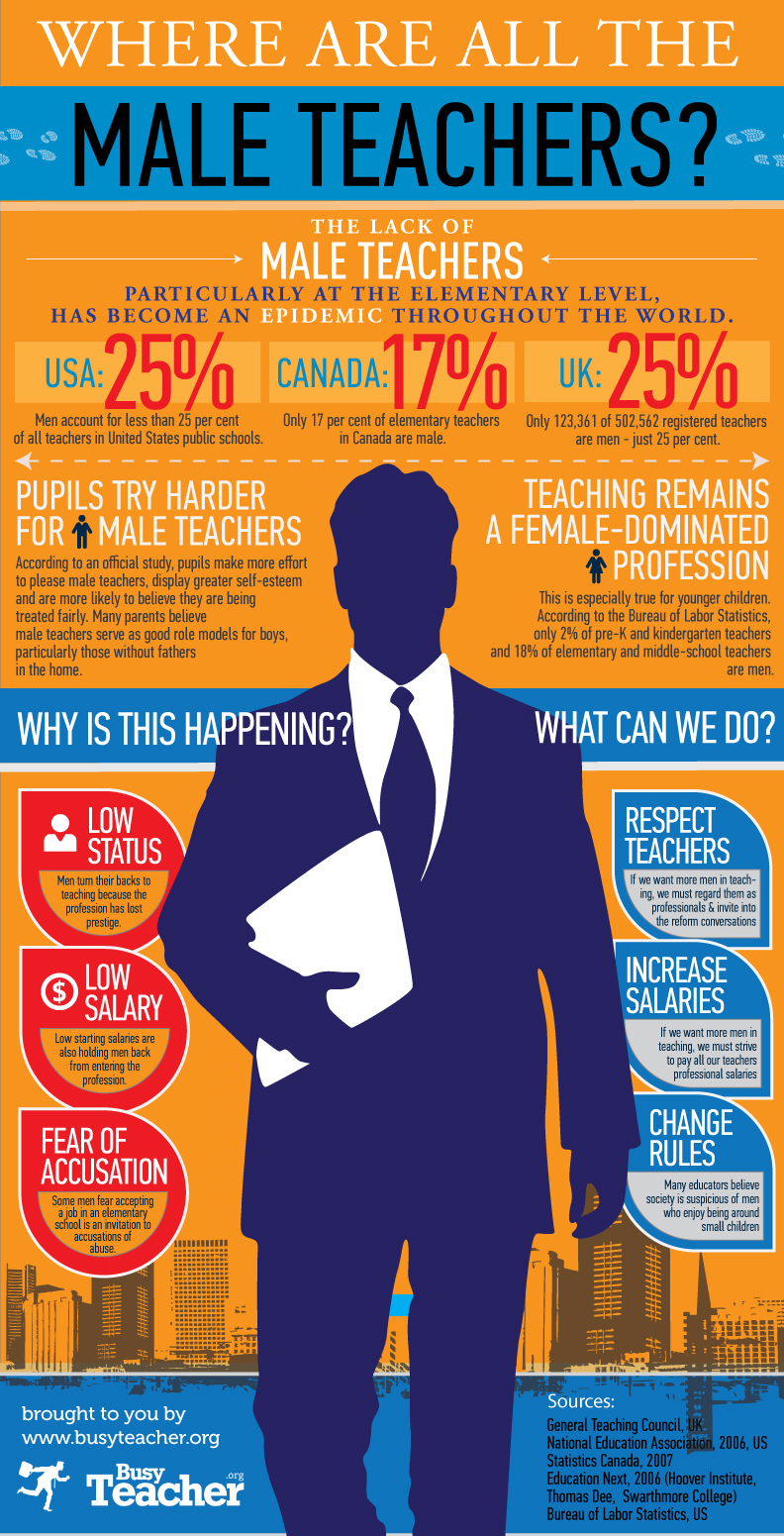
This infograph gives a quick overview:
The part that stood out to me the most on this image is that "pupils try harder for male teachers." Anecdotally, I have seen some students work much harder for a male teacher than their homeroom female teacher. However, I think teacher and student personality played a large factor in the situation I am thinking of.
Searching around, I found this article from the National Bureau of Economic Research: Teachers and the Gender Gaps in Student Achievement.
The study is a little dated (1988), but it examined student outcomes (test scores, perceptions of performance, intellectual engagement like looking forward to class, finding it useful, and feeling comfortable asking questions) based on gender interactions in the classroom.
Some interesting take-aways:
But interesting... I'd like to see more research on the subject before jumping to conclusions. However, I am willing to say that I actively support more men in elementary schools and more females in STEM positions. It is important to have students see male and female role models (read teachers) in all positions.
In most of these discussions, however, the topic is almost always women. What about men? In a female-dominated field like education, the tables are turned and men are in the minority.
This infograph gives a quick overview:
The part that stood out to me the most on this image is that "pupils try harder for male teachers." Anecdotally, I have seen some students work much harder for a male teacher than their homeroom female teacher. However, I think teacher and student personality played a large factor in the situation I am thinking of.
Searching around, I found this article from the National Bureau of Economic Research: Teachers and the Gender Gaps in Student Achievement.
The study is a little dated (1988), but it examined student outcomes (test scores, perceptions of performance, intellectual engagement like looking forward to class, finding it useful, and feeling comfortable asking questions) based on gender interactions in the classroom.
Some interesting take-aways:
- Dee finds that gender interactions between teachers and students have significant effects on these important educational outcomes.
- Assignment to a teacher of the opposite sex lowers student achievement by about 0.04 standard deviations.
- Other results imply that just one year with a male English teacher would eliminate nearly a third of the gender gap in reading performance among 13 year olds and would do so by improving the performance of boys and simultaneously harming that of girls.
- Similarly, a year with a female teacher would close the gender gap in science achievement among 13 year olds by half and eliminate entirely the smaller achievement gap in mathematics.
- Boys were more likely to report that they did not look forward to a particular academic subject when it was taught by a female.
But interesting... I'd like to see more research on the subject before jumping to conclusions. However, I am willing to say that I actively support more men in elementary schools and more females in STEM positions. It is important to have students see male and female role models (read teachers) in all positions.
Thursday, August 1, 2013
Top US Problems - Not Education
*Alternative Title: I've Got 99 Problems But Education Ain't One
A new Gallup Poll came out last week asking what the "most important problem" in the U.S. is.
Here are the results in a nutshell:
Here are the results broken down by demographic group:
Education is dead last? Woo hoo! Right?
My feelings are mixed on the results of this poll. While it is good that education is not perceived as a "major problem," I feel that education relates to all of the other concerns on the list. At the very least education has a direct impact on the top two concerns - the economy and unemployment/jobs.
I'm glad education is not seen as our biggest problem. However, if the country gave education more attention and placed a greater emphasis on its importance, then maybe we can help those other categories become less of an issue.
Off my soapbox...
A new Gallup Poll came out last week asking what the "most important problem" in the U.S. is.
Here are the results in a nutshell:
- Economy in General - 23%
- Unemployment/Jobs - 19%
- Healthcare - 11%
- Government/Congressmen/Politicians - 10%
- Federal Deficit -8%
- Ethics/Moral/Religious/Family Decline; Dishonesty - 7%
- Poor Leadership/The President/Corruption/Abuse of Power -6%
- Immigration - 6%
- Education - 5%
Here are the results broken down by demographic group:
Education is dead last? Woo hoo! Right?
My feelings are mixed on the results of this poll. While it is good that education is not perceived as a "major problem," I feel that education relates to all of the other concerns on the list. At the very least education has a direct impact on the top two concerns - the economy and unemployment/jobs.
I'm glad education is not seen as our biggest problem. However, if the country gave education more attention and placed a greater emphasis on its importance, then maybe we can help those other categories become less of an issue.
Off my soapbox...
Friday, July 26, 2013
Education Spending and Performance Across 12 Countries
Here is an interesting infograph from USC:
It gives a clear visual of the fact that while the US spends the most per student, our results quickly fall off the mark. I feel like people often look at this and then "blame the teacher." You hear things like "teachers get paid too much for doing too little," or "Yeah, I'd like a three month paid vacation, too!" and most often, "Cut education spending!"
One important thing missing from this infograph, however, is how and where that money is spent. I would find this much more interesting if it provided a breakdown WHERE that money is spent in each country and then relate that to student outcomes. That would be a much better indicator of how we could make policy changes for the better.
Your thoughts?
It gives a clear visual of the fact that while the US spends the most per student, our results quickly fall off the mark. I feel like people often look at this and then "blame the teacher." You hear things like "teachers get paid too much for doing too little," or "Yeah, I'd like a three month paid vacation, too!" and most often, "Cut education spending!"
One important thing missing from this infograph, however, is how and where that money is spent. I would find this much more interesting if it provided a breakdown WHERE that money is spent in each country and then relate that to student outcomes. That would be a much better indicator of how we could make policy changes for the better.
Your thoughts?
Tuesday, July 16, 2013
Resource Round-Up: July 16, 2013
Today's resource round-up is a mixed-bag:
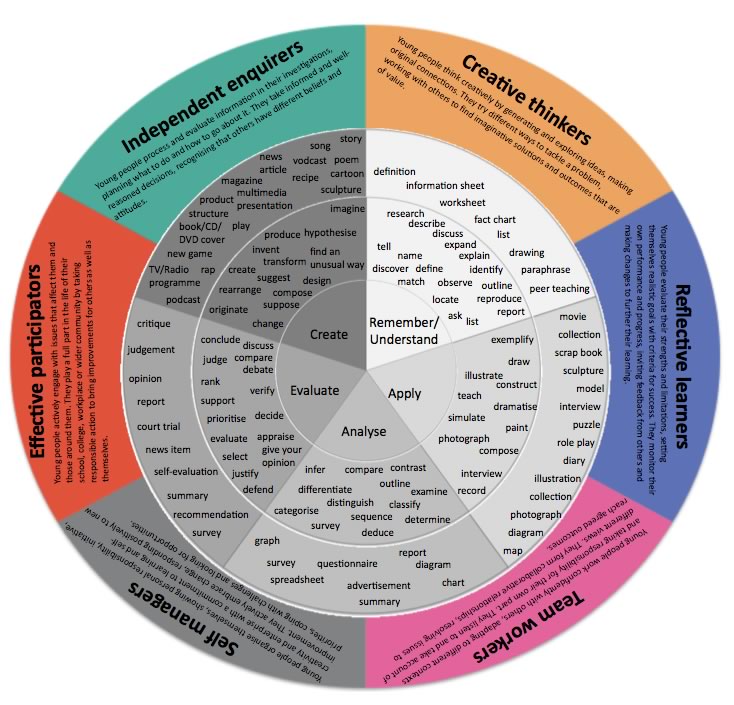
1. Taxonomy Wheel - A new visual for Bloom's Taxonomy that takes the type of learner into account
2. Gender Bias in the Classroom from TeachThought
3. Well-Behaved Students and Engaged Students Aren't the Same Thing from Education Week
1. Taxonomy Wheel - A new visual for Bloom's Taxonomy that takes the type of learner into account
2. Gender Bias in the Classroom from TeachThought
3. Well-Behaved Students and Engaged Students Aren't the Same Thing from Education Week
Wednesday, May 29, 2013
TED Talks: How to Escape Education's Death Valley
And another intriguing TED talk:
How to Escape Education's Death Valley
What do you think?
How to Escape Education's Death Valley
What do you think?
Sunday, May 12, 2013
TED Talks: My Confession...
I LOVE TED Talks!
It's true... they are interesting, thought-provoking, and can strike a chord.
I like things that make me think, and TED talks do that.
Here is a recent TED talk that hits home for educators: Bill Gates: Teachers Need Real Feedback
When I think of the feedback I have received over my handful of years teaching, meaningful and pertinent feedback has been sparse.
Teachers want to find new and better ways to help their students succeed. Meaningful feedback is one important component to cultivating our teaching practices and strategies.
- Do you receive meaningful feedback?
- What is the most helpful feedback you have ever received?
- How do you think school can improve to provide better feedback for teachers (and administrators!)?
Subscribe to:
Comments (Atom)