I've seen two videos recently that have really made me stop and think about how we talk to girls in our society. Here they are:
1) Like a Girl
2) Inspire Her Mind
As a female, I know personally how the deck can be stacked against us in certain ways. Also, as a teacher I see many of the same sayings, thoughts, and stereotypes placed on our young ladies today.
I know kindergartners who are concerned about wearing high heels (usually a small platform on the bottom of their shoe) and if they need more lip gloss. I'm not exaggerating here. These two girls that I am thinking of - ages 6 and 7 - cannot identify or write many of the letters of the alphabet, they used to struggle with even identifying their names if they were spelled out in front of them, and they cannot write or identify all of the numbers 1-10.
These girls are not stupid. They are very intelligent, but the message they have been given from a very, very young age is that their appearance is more important than anything else, especially school or any kind of 'work' like reading or doing math.
When this message is made clear to girls, it also translates into expectations for boys. While in kindergartner most boys think girls have cooties, as they grow up around girls who increasingly focus on their appearance, since that is what girls are directly and indirectly told is important, boys will start to conform and expect that stereotyped standard as well.
We need to be even more cognizant of the language we use with young children and the messages, intended or not, that we send them.
We can do more for our girls.

Showing posts with label Gender. Show all posts
Showing posts with label Gender. Show all posts
Monday, June 30, 2014

Monday, August 19, 2013
Why Aren't More Girls Attracted To Physics?
Here is a quick four and a half minute story from NPR: Why Aren't More Girls Attracted To Physics?

The one factor that effects whether more girls take physics in high school: the number of women in the community whose work relates to math and engineering.
Seems like a Catch 22:
To get more women involved in STEM there needs to be more female role models who are involved in STEM.

The one factor that effects whether more girls take physics in high school: the number of women in the community whose work relates to math and engineering.
Seems like a Catch 22:
To get more women involved in STEM there needs to be more female role models who are involved in STEM.
Saturday, August 3, 2013
Gender in Teaching
Often the media discusses inequities between genders in the workforce. The current book Lean In caused some backlash as author Sheryl Sandberg discussed gender in relation to work and leadership.
In most of these discussions, however, the topic is almost always women. What about men? In a female-dominated field like education, the tables are turned and men are in the minority.
This infograph gives a quick overview:

The part that stood out to me the most on this image is that "pupils try harder for male teachers." Anecdotally, I have seen some students work much harder for a male teacher than their homeroom female teacher. However, I think teacher and student personality played a large factor in the situation I am thinking of.
Searching around, I found this article from the National Bureau of Economic Research: Teachers and the Gender Gaps in Student Achievement.
The study is a little dated (1988), but it examined student outcomes (test scores, perceptions of performance, intellectual engagement like looking forward to class, finding it useful, and feeling comfortable asking questions) based on gender interactions in the classroom.
Some interesting take-aways:
But interesting... I'd like to see more research on the subject before jumping to conclusions. However, I am willing to say that I actively support more men in elementary schools and more females in STEM positions. It is important to have students see male and female role models (read teachers) in all positions.

In most of these discussions, however, the topic is almost always women. What about men? In a female-dominated field like education, the tables are turned and men are in the minority.
This infograph gives a quick overview:
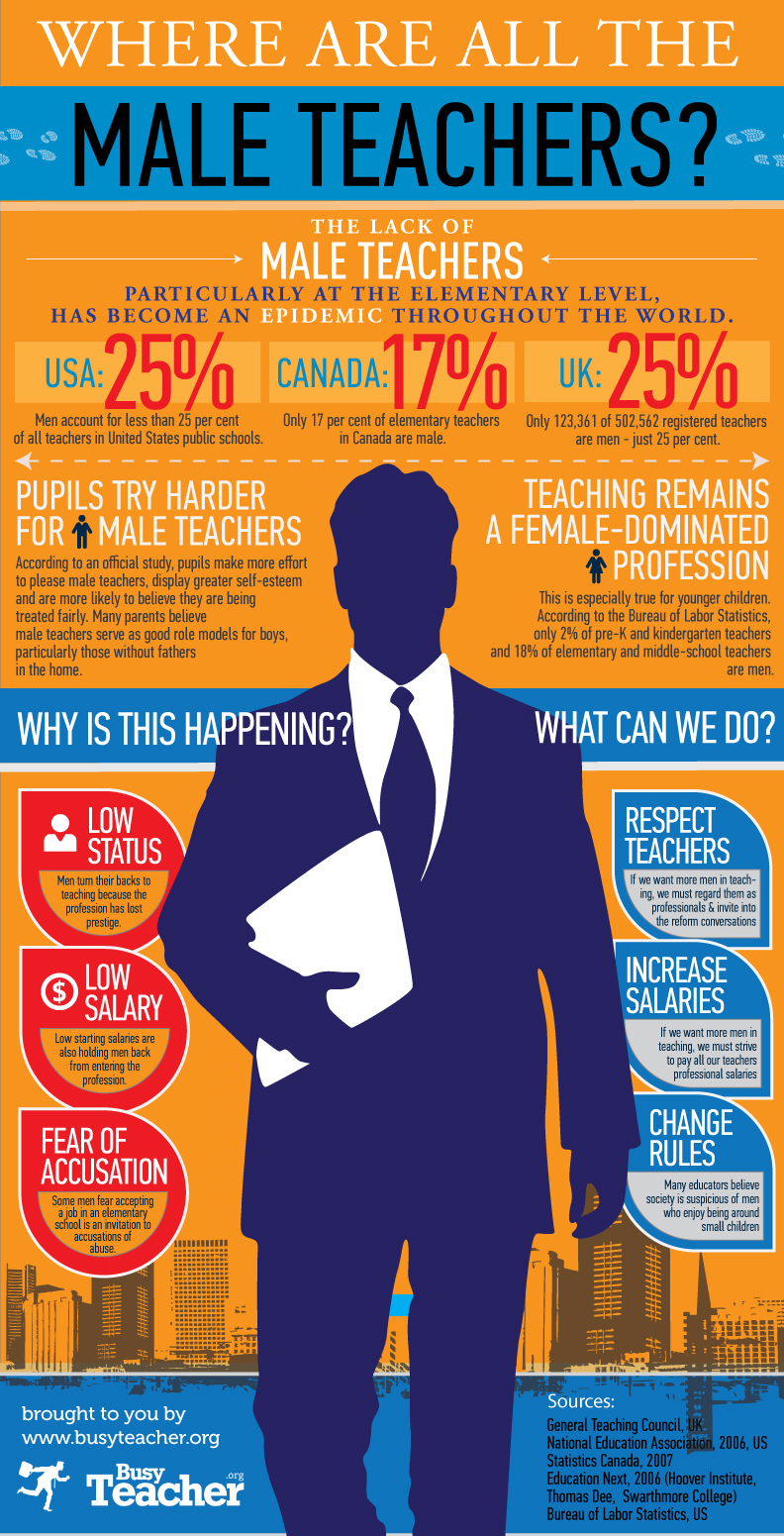
The part that stood out to me the most on this image is that "pupils try harder for male teachers." Anecdotally, I have seen some students work much harder for a male teacher than their homeroom female teacher. However, I think teacher and student personality played a large factor in the situation I am thinking of.
Searching around, I found this article from the National Bureau of Economic Research: Teachers and the Gender Gaps in Student Achievement.
The study is a little dated (1988), but it examined student outcomes (test scores, perceptions of performance, intellectual engagement like looking forward to class, finding it useful, and feeling comfortable asking questions) based on gender interactions in the classroom.
Some interesting take-aways:
- Dee finds that gender interactions between teachers and students have significant effects on these important educational outcomes.
- Assignment to a teacher of the opposite sex lowers student achievement by about 0.04 standard deviations.
- Other results imply that just one year with a male English teacher would eliminate nearly a third of the gender gap in reading performance among 13 year olds… and would do so by improving the performance of boys and simultaneously harming that of girls.
- Similarly, a year with a female teacher would close the gender gap in science achievement among 13 year olds by half and eliminate entirely the smaller achievement gap in mathematics.
- Boys were more likely to report that they did not look forward to a particular academic subject when it was taught by a female.
But interesting... I'd like to see more research on the subject before jumping to conclusions. However, I am willing to say that I actively support more men in elementary schools and more females in STEM positions. It is important to have students see male and female role models (read teachers) in all positions.
Subscribe to:
Posts (Atom)
